
Overview
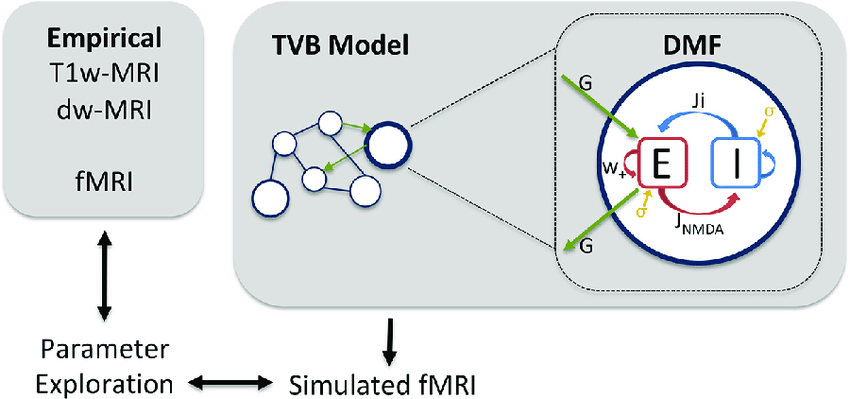
This topic focuses on advancing the scientific and clinical foundations of Virtual Brain (VB) models by combining data-driven biomarker discovery, model validation, and mechanistic simulation of neurostimulation.
Virtual Brain models offer a powerful framework for constructing patient-specific digital representations of brain dynamics, but their clinical adoption depends critically on:
- Robust and scalable model fitting strategies
- Reliable biomarkers linking data to model parameters
- Accurate simulation of brain response to stimulation
This research line addresses these challenges through an integrated approach that bridges neuroimaging, machine learning, and dynamical systems modeling, with a particular focus on tinnitus and related disorders, while remaining generalizable to other neurological conditions.
Research Direction
The overarching goal is to enable personalized, predictive brain models that can:
- Capture individual variability using multimodal data (EEG, MRI, clinical metadata)
- Identify mechanistic biomarkers linked to disease and treatment response
- Simulate network-level effects of neurostimulation
- Support precision neuromodulation strategies
Key questions include:
- What are the most robust ways to fit Virtual Brain models to empirical data?
- Which biomarkers best capture disease-relevant brain dynamics?
- How do different modeling assumptions influence predictions under stimulation?
- Can we move beyond correlation (FC) toward mechanistic interpretability?
Available Thesis Projects
VBT#1 — Benchmarking and Optimization of Fitting Strategies
Focuses on systematic evaluation and improvement of model fitting pipelines.
- Benchmark FC-based fitting approaches across parameter spaces
- Assess the role of structural connectivity and anatomical personalization
- Investigate generalization when patient-specific data is incomplete
- Explore alternative biomarkers beyond FC (e.g., dynamical or disease-specific markers)
Outcome: Robust, scalable methodologies for fitting Virtual Brain models to diverse datasets.
VBT#2 — Biomarker Identification for Tinnitus
Focuses on data-driven discovery of neural correlates and patient subtypes.
- Integrate multimodal neuroimaging (EEG, MRI) with clinical data
- Identify biomarkers linked to symptom severity and treatment response
- Perform subgroup discovery to uncover tinnitus phenotypes
- Explore mechanistic interpretations of observed patterns
Outcome: Clinically relevant biomarkers enabling stratification and personalization in tinnitus.
VBT#3 — Neural Mass Models and Neurostimulation Response
Focuses on mechanistic modeling of brain dynamics under stimulation.
- Analyze neural mass and dynamic mean-field (DMF) models
- Simulate response to electrical or magnetic stimulation
- Compare model formulations in terms of realism and predictive power
- Study impact on functional connectivity and fitting performance
Outcome: A structured framework for selecting and validating models for personalized neuromodulation.
Expected Impact
This integrated research line will contribute to:
- Transition from descriptive to mechanistic, personalized brain models
- Improved clinical decision support for neuromodulation therapies
- Identification of robust biomarkers for patient stratification
- Foundations for Digital Brain Twins in neurological disorders
Positioning
This topic sits at the intersection of:
- Computational neuroscience (Virtual Brain, neural mass models)
- Machine learning and statistical modeling
- Neuroimaging and clinical neuroscience
- Personalized medicine and neuromodulation
It is particularly suited for students interested in combining data-driven approaches with mechanistic brain modeling, and in contributing to the development of next-generation clinical decision-support systems.
IMPORTANT: When applying for a thesis, always attach your CV, course list and course grades to your application so as to ensure best fit with the topic at hand!